Imagine: a non-technical founder hires a development partner to build their product. Work gets done, deliveries happen, course corrections are made based on feedback along the way. Yet something feels off—despite both sides being competent and well-intentioned. This article extends the Strategy-to-Execution Continuum to explain why this gap exists—and how to bridge it.
Strategic technical decisions are complex and the stakes are high. I work with founders and executives to navigate these challenges. Reach out if you'd like an outside expert perspective.
… or continue reading
The gap that neither side can name
A common scenario: founders hire a development partner to build their product. Early conversations go well. Work begins. Then, gradually, unease sets in.
The founders feel uncertain. Real money is flowing out, but they can't tell if things are on track. They don't know what questions to ask. If they get more involved, it starts feeling like micromanagement—which helps no one.
The development partner feels adrift. They're not getting the guidance they need. They make decisions that feel like they should come from the founders, but the founders aren't equipped to make them.
Neither side is doing anything wrong. They are experiencing a gap they do not know how to bridge.
Extending the Strategy-to-Execution Continuum
In an earlier article, I introduced the Strategy-to-Execution Continuum (SEC): a scale from strategic decisions (left) to execution tasks (right). Different roles have visibility spans—ranges on this continuum where they can see and operate effectively. Communication works when these spans overlap.

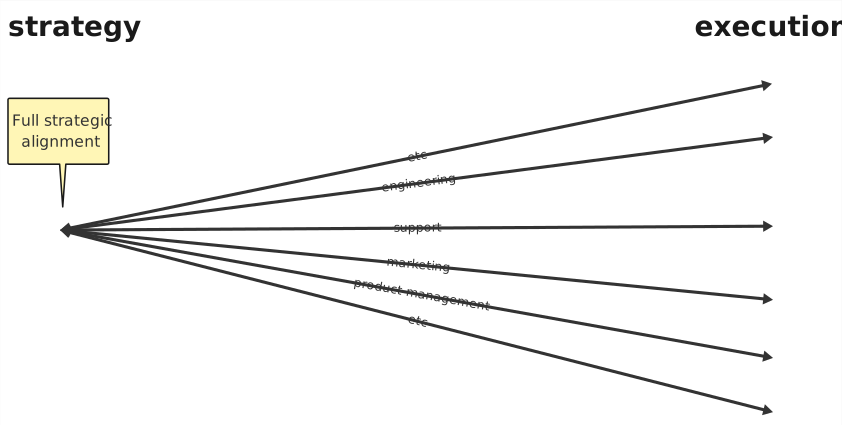
But that model assumes everyone operates on the same line. In reality, different job families—business, product, engineering, QA—each have their own line.
These lines are not parallel. At the strategic end, all functions converge on the same point: the company's purpose. Everyone should be aligned here. At the execution end, functions diverge into completely different activities. An engineer's execution work looks nothing like a product manager's execution work.
The shape is a funnel. One shared anchor on the left, branching outward toward the right.
Mapping the founder-developer gap
Now we can map the original problem.
Founders sit on the business branch of the funnel, toward the left. Their work is strategic: vision, direction, priorities. Development partners sit on the engineering branch, toward the right. Their work is execution: building, shipping, solving technical problems.
The gap between them is diagonal—different functions AND different positions on the continuum. This is maximum distance in the model.
This explains why neither side can bridge the gap alone. The founders can't reach far enough right and down. The development partner can't reach far enough left and up. Getting more involved doesn't help the founders—it just creates micromanagement without closing the real gap.
How a Fractional CTO bridges this gap
A Fractional CTO sits in the middle of the funnel.
Their visibility spans from strategy into execution—they can discuss company direction with founders and sprint planning with developers. They're fluent across the business and engineering branches—they understand commercial constraints and technical trade-offs.
This isn't about fixing dysfunction. The founders and development partner were never dysfunctional. There was simply a structural gap that neither could bridge from their position.
The CTO translates in both directions: strategic intent moves rightward into technical requirements; technical constraints and progress move leftward into business implications. Both sides gain visibility they didn't have before.
When communication fails across roles, measure the distance first. Some gaps are too wide to bridge from either end—not because of skill or effort, but because of position in the funnel.
Ivo Timmermans is the founder of Sparqpath, where he works as a fractional CTO and strategic technology advisor, helping companies navigate complex technical decisions including outsourcing strategy and vendor relationships.